Monday, May 18, 2026

A journey of faith


Rising dramatically on the outskirts of Kuala Lumpur, Batu Caves stands as one of
Malaysia’s most iconic cultural and spiritual landmarks. The 400-million-year-old limestone
caves are home to one of the world’s most sacred shrines dedicated to Lord Murugan also
known as Kartikeya / Kartik / Subramanya. Lord Murugan is the Hindu god of war and
victory. Guarding the entrance to the caves is the towering golden statue of Murugan,
soaring nearly 140 feet high and now recognized as one of Malaysia’s defining tourism
symbols.
Batu Caves


Every year, the caves become the heart of one of the world’s largest Thaipusam
celebrations. Observed on the first full moon of the Tamil month of Thai, usually in late
January or early February, Thaipusam is deeply significant to Malaysia’s large Tamil Hindu
community. Though Malaysia is a Muslim-majority nation, nearly two million people of Tamil
origin continue to preserve this vibrant tradition with extraordinary devotion.
This year Thaipusam was celebrated on 1 st Feb and both I and my husband had the privilege
of being there. The journey started a year ago when my husband visited the sacred shrine
on Thaipusam 2025 to direct and shoot a music video for the acclaimed artist Sid Sriram
singing Sivanar, a Thiruppugazh which is one of most revered devotional songs dedicated to
Lord Murugan. Thiruppugazh are written by 14 th Century poet saint Arunagirinathar. For the
Tamil people Arunagirinathar is an extremely revered poet saint and the Thiruppugazh are
the soul of worshiping Murugan. Like our Srimanta Sankardeva, Sri Sri Madhavdeva and
their borgeet.
The festival commemorates the moment when Goddess Parvati gifted Murugan the divine
Vel, or celestial spear, to defeat the demon Surapadman and his brothers. According to the
Tamil belief, Murugan split Surapadman in two after the demon transformed himself into a
mango tree to escape defeat. Surapadman rather than die in the literal sense, it’s said,
experienced the death of his pride and ego. Rather than destroying him completely, Murugan
transformed the demon into a peacock and rooster, symbols that became part of his own
iconography. The story represents the triumph of humility over ego and the possibility of
redemption through divine grace.
Another legend central to Thaipusam is the story of Idumban, a devoted disciple tasked with
carrying two sacred hills from the Himalayas to South India. Exhausted during his journey,
Idumban rested in present-day Palani, only to discover he could no longer lift the hills
because Murugan himself stood upon them disguised as a child. After a confrontation,
Idumban realized the child’s divine identity and humbly sought forgiveness. Murugan,
impressed by his dedication and perseverance, blessed all future devotees who would
symbolically follow in his footsteps.
This tradition lives on through the carrying of kavadi, or “ceremonial burdens,” during
Thaipusam. Devotees shoulder decorated wooden structures or carry pots filled with milk,
honey, and fruit as offerings to Murugan. The demanding physical journey is viewed as an
act of spiritual purification, discipline, and surrender. Some devotees chose to go the
extreme penance by piercing body parts. They say, it never hurt.
Nowhere is this devotion more vividly displayed than at Batu Caves. What began in the late
19th century as a modest shrine established by Tamil leader K. Thambusamy Pillai has
evolved into a vast temple complex attracting millions of pilgrims and visitors annually.
During Thaipusam, the atmosphere transforms into a spectacular fusion of music, dance,
prayer, and color. The colour yellow is significant for Lord Murugan. Devotees accompany
Murugan’s image on an elaborate silver chariot during a nine-mile procession through the
city. By the time they reach the base of Batu Caves, exhaustion is visible, yet the immense
golden statue of Murugan inspires one final act of devotion — the climb up the famous 272
rainbow-colored steps leading into the sacred cave temple.


At the summit, pilgrims offer their prayers in gratitude and surrender, completing a journey
that is as much spiritual as physical. More than a festival, Thaipusam at Batu Caves is a
profound expression of faith, resilience, and transformation, making it one of Southeast
Asia’s most unforgettable cultural experiences.

We didn’t climb the steps on the Thaipusam day. We chose to sit on the temple ground,
watching the devotees carrying those heavy ‘Kavadis’ and to soak in the devotion in the air.
We went back after 2 days early in the morning, climbed the rainbow steps and offered our
prayers and gratitude to the Lord. We sought permission from the pujari to play Sivanar to
Murugan. He agreed. It was a full circle moment for us!


Thursday, June 11, 2020

Axone - More than just a film


Finally the film is releasing! I have been getting queries from my friends and friends' friends asking about “ How and Where to see this film” since last one year. Why me? Because I am “related” to someone very closely associated with the film. But hang on everyone, this is not a good / bad / paid review. I am writing how I felt watching AXONE . That’s it.

For those who don’t know, Axone or Akhuni is a dish from the North Eastern part of India. Various states among the 8 sisters use Axone in their cuisine in different forms and of course different names.
The official poster

Axone is fermented soya beans and because of the high protein content in these beans, in their
fermented stage, they smell like putrefaction. Well to many! The “stench” is such that when Delhi Police had a directive - “ Security tips for North east students / visitors in Delhi” in 2007- it mentioned Axone alongside bamboo shoots as a food item to be AVOIDED.

That “Directive” had many do’s and don’ts for people from North east in Delhi. After spending a couple of years in Delhi from 2004-2006, I was already back in Assam in 2007. If you ask me, if I had faced any issues because of the way I look or what I cook; no I didn’t. But while house hunting, I have seen people looking more curiously towards my younger sister whose Mongoloid features were more prominent than me. We managed to find a place / one room with an attached bathroom in Safdarjung Enclave, South Delhi. When we were leaving that place, me to move back to Assam and sister to a shared apartment with other girls, our landlady said “ How do we find people like you now!”
Sayani Gupta and Tenzin Dalha in a scene from Axone


Axone  is a small quirky lighthearted take on some bigger issues. A group of friends
want to cook Axone pork for their friend who is getting married that day. How they manage to do that, hiding its overpowering smell and hiding / facing / moving on with the stench of soft racial discrimination all around. The place where this story is based, is not very far from where we used to live. Of course in 2004, the place was “little” different than what it has evolved to be now.

Written and directed by Nicholas Kharkongor and Produced by Yoodlee Films, Axone offers many moments which anyone from North East staying outside the 8 sisters can identify with. That is why when the trailer was released a year ago, people lapped it up. You go to the Axone trailer on Youtube and read the comments and you will understand what I am talking about. This has become an emotion for many from North East India, staying in various parts of India and the World.

Lanuakam Ao / Bendang in Axone
It  is very human to be doubtful / wary of things unknown or something you are not familiar with. Don't we all have our doubts when stepping out of our comfort zones? Likewise in the film, people from the “mainland” are wary of these bunch who look different, speak alien languages and eat very very different stuff. For Example; in one scene a “local” guy casually passes an offensive remark to Chaanbi or when another character states “ How can I tell you apart, you all look the same!”. All these because the so called “ others” look different. That has led to some walls. It is not one sided though. In the film , when Bendang tries, fails and says “ I don’t sing Hindi songs” , he builds up a wall too. We from Northeast are as much a part of this country as anyone from any other part. What is the harm in learning and singing a Hindi or even a Punjabi song? The walls need to be broken from both sides. I firmly believe that. His story has hints of a rather infamous incident of violent racial attack on someone from North East. Sadly the person lost his life. Bendang here gets a second chance.

The film has some characters which are very stereotypical. I felt all the characters from the landlady's family were such. But they exist and Shiv aka Hyper steals the show with his "over enthusiasm". For every slur you receive, you wish you have a friend like Hyper who sticks with you without judging you.

Racial discrimination is an issue the world is battling with. As someone from Northeast India, I am not being biased to people from our part of the country. But in my 2 years in Delhi, I never disliked it. I still love visiting Delhi. Now living in Mumbai I have turned into a true blue Mumbaikar running in and out of local trains 5 days a week. ( That’s a validation my Bambaiyya dost log have given). Why Axone worked for me is because it tries to show both sides; though subtly, but it does and that’s the reason I root for this film.


Axone is releasing on Netflix on 12th June 2020. Go watch it and share your thoughts. I bet you have never seen this part of Delhi in any other Hindi film :)


Poster credits : Yoodlee films and Parasher Baruah.


Sunday, August 19, 2018

Chicken Vindaloo

Four years ago my Father In Law gifted me a recipe book called 101 Parsi Recipes by Jeroo Mehta. Until then I had never heard of her. It is only then I realised that Jeroo Mehta is considered to be the doyenne of Parsi Cuisine. The book was first published in the year 1973 much before I was born! Since my experiments in the kitchen were growing, this was a very welcome addition in my kitchen.

To be honest I didn't make too many dishes from the book in all these years except for few egg recipes. This weekend I thought of celebrating the Nowruz / Navroze or the Parsi New Year by making Chicken Vindaloo from the book. I followed the recipe as much as I could; but had to make few "adjustments" here and there. Like the Assamese in me, prompted me to use Mustard oil. It's a belief that non vegetarian dishes taste better if cooked in Mustard oil. That's something I can't change though I have tasted many dishes cooked in various other oils and they taste super. All in the mind you see.

Here's the recipe as I followed - 

INGREDIENTS

1/2 kg Chicken ( I was only cooking for myself)

1 large onion, finely sliced

2 dried Red Kashmiri chilies.

1 tea spoon of Ginger Garlic Paste.

1/2 teaspoon of cumin seeds.

One major change here that I did was that I used the ready made Ginger Garlic paste. Mehta's recipe suggested that one piece ginger, 4-5 garlic cloves,  1/2 teaspoon cumin seeds and the kashmiri red chilies were to grind to a paste with 2 tablespoon of vinegar. I just ground the red chillies with vinegar.

2 Table spoons of vinegar to cook.

1 Cinnamon stick

2 Green Chillies, slit and seeded ( optional) 

1/2 Teaspoon Sugar

1 Teaspoon salt or as per your taste.

2 Tablespoons oil to cook ( It was vegetable oil in the book, I used mustard oil )


METHOD

Heat oil and fry the sliced onion till they become pale golden.
Add the ginger garlic red chilies vinegar masala paste and cook for another 5 minutes. Add the chicken pieces, 2 tablespoons vinegar, cinnamon stick, green chilies and salt. I would like to mention here that the chicken that I had at home was boneless. Mix everything together well and let the chicken cook for 10 minutes. 
Add one cup of hot water, bring to boil then simmer, covered till the chicken is cooked. 

The recipe mentioned to add few small potatoes at this stage. I skipped that. 

When the chicken is cooked, add sugar as per your taste.

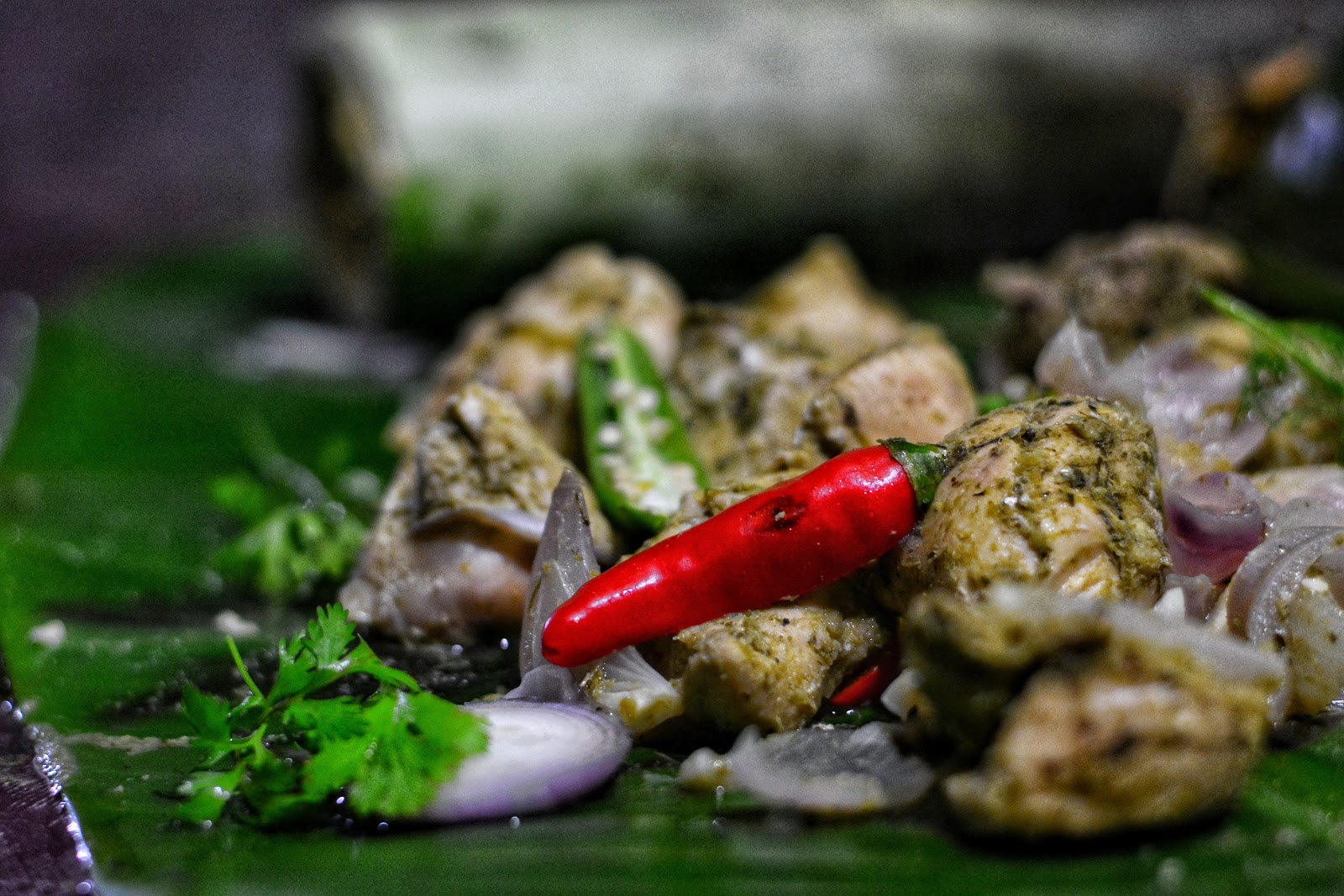
I must say, the result was something I myself relished so much. I had that with Masoor Pulav. 
But the chicken was definitely the highlight of the lunch. Hence, after a long time I decided to share this a recipe in my blog. 


Sunday, June 10, 2018

Magic of Millions of Fireflies

Top post on IndiBlogger, the biggest community of Indian Bloggers


The memories of my Enai's ( that's my maternal grand mother) home in Meleng, Jorhat are many and one very vivid memory that I still have in my mind is that of hundreds of twinkling fireflies. Enai's home has quite a big ground in front and there were paddy fields around. I am talking about 1985 here. In our summer vacations all our cousins would gather at her place and spend some time there. Electricity was erratic and it still is. Evenings when there was no electricity, we would sit in the long verandah and listen to Puthau's ( grand father) stories. And then fireflies would come twinkling. Some of us would run after them to catch them in our hands. Enai would shout " Don't touch them. Otherwise in the night you will have to go to the toilet!" Now that's something all of us wanted to avoid. The bathroom was outside of the main house. Just outside in the backyard. But if you had to go to the toilet at night, you had no option but to wake up an elder. If there was no electricity then, imagine the shadows on the wall from the flickering light of the hand lamp! No way.

Last week, I and P had been to Purushwadi. We heard about the place from a friend. She said " You have to see it to believe what I am telling you." We were intrigued. Every year just before the monsoons, millions of fireflies come to this tiny village and put up a spectacular light show, which now I also say " You have to see it to believe it." 

The Valley


We went to Purushwadi through Grassroutes They aim at , in their own words, " to create 1 million livelihood opportunities in Rural India." They have various stay options available. We opted for the canvas tents. There are shared western toilets with running water too. But please donot expect all the luxuries of the city life that we are used to there. That is NOT the idea and we must respect that. 

Valley facing Tents

We went by local train to Kasara from Dadar. In Kasara there are shared jeeps available which will drop you till Rajur, the nearest "town" to Purushwadi. From Rajur another jeep to Purushwadi. You can take your own vehicle too. Purushwadi is about 220 km from Mumbai in Ahmed Nagar district. The jeep travel part can be a bit harrowing. They stuff people into one vehicle way more than it's capacity. 


Lunch
We reached the camp site by afternoon. All your meals will be at the village at a villager's home. Our hosts were ready with lunch. It's a simple vegetarian meal of what they also eat. We loved every bit. We thought of lying down for about an hour as were up since 4am. But it was too hot. But to our surprise, by 4pm we could clearly see the clouds coming in. The breeze got cooler and suddenly the sky opened up. It started pouring heavily. We enjoyed the weather with local mangoes. Since it rained we were in two minds about the sunset trek. But thanks to another couple that we met there, we just went out for a hike. Grassroutes assign one household in the village for each of the guests and that keep rotating thus making sure that everyone gets equal opportunity. All four of us were hosted by the same family. We went up to the Sun set point even though there was no " sun set view". But for all of us, we enjoyed the small hike, rains and the weather. 


Our gracious hostess


There was no electricity in the village after the storm. The camp site was lit by solar lamps. As we walked to our host's home for dinner, already the tiny twinkling lamps were everywhere. Our guide told us that it was just a trailer and the full show was still to come. How true was that. After dinner we started our walk to witness the magic of million fireflies. All along the way there were thousands of them. Then we were there. Standing across a bridge, we saw a light show put by amazing nature. The tree looked like glittered with thousands of tiny Christmas lights. The fireflies were illuminating all over.  But it was so synchronized that we were awestruck. We just stood there silently witnessing this phenomenon. We returned to our tents happy.


Magical Fireflies


Next morning after a delicious Poha breakfast, our guides took around the village giving us a glimpse into their daily lives. Even though it had stopped raining, the weather was little humid but thankfully not scorching hot. We walked till the river, but we did not take a bath. Just sat there remembering Enai - Puthau and the fireflies.


Friends met there and our guides Sandip & Avdesh


Sunday, May 20, 2018

Harud by the lake

We, i.e. P and I, love Kashmir. It's the place, the food, the people and the stories which have struck a chord with us. 

The last time we were in Srinagar, Kashmir; for me it was for a really short time. Only 2 days. It so happened that P was working there. When his work got over, it was a Thursday. So we decided that he would stay back and I would join him over the weekend. Those were the last few days of Autumn, sometimes in  early Novermber. It was about to rain and then the red leaves of the chinar trees would start  to fall, heralding the onset of a bitter winter.  Since last 3 years I was planning to be in Kashmir during Autumn, when the Chinars turn red!Every year something would come up and I would miss it. 

Kashmir has it's own charm during all the seasons. And we fell in love with the beautiful Harud (autumn) there. The slight chill in the air, the dry leaves in the trees, those big chinars with their red/brown leaves - everything added to the beauty of this heaven on earth. For those 2 days, we  roamed around the city at our own pace. Walked around the Nishad Garden and Chinar bagh. Sipped Kahwa from roadside small eateries,visited the famed sufi shrine of Khanqah-e-Moula .Looked for Rainbow bakery and had their amazing walnut brownie.We even  made plans with our friendly and trusted Auto driver Manzoor bhai to go to Downtown Srinagar at 5 am to have Harissa,a winter specialty served by just a handful of restaurants in the morning. But alas the last thing we couldn't do because on that day, our last day in Srinagar, there was a bandh called for and Manzoor bhai refused to take any risk by taking us there.

Slightly disheartened we came to Daal lake for a stroll before we left the city. We just sat by the lake, doing nothing just looking into this beautiful lake that defines the city. There were very few "tourists" that early in the morning. The sky was still gloomy after the previous night's shower. As we sat there, the sky slowly started to open up. There was still a light mist in the distance.For Kashmir the last 2 years had been really dismal in terms of tourism. Hotels and Houseboats were empty, shikaras were running into losses. The Shikara owners we got talking to told us how  bad the previous "seasons" were.

But still there was some hope; that the coming year would bring in peace and people will be back to enjoy a Shikara ride on Daal lake. We looked towards the lake and as we were about to leave, P said " Let's take one selfie with the daal lake". We looked out and P hit the click button on his phone, just in time to capture the Shikara in the frame too.

It was a beautiful moment captured in our minds and in P's Selfie Camera forever. 


Selfie with the Shikara

Just like this beautiful moment, there are many more special moments that we want to keep frozen in our lives forever. Here comes Mobiistar ; who has entered Indian market with plans to develop the smartphone segment in India by understanding the consumer need for a selfie smartphone and their desire to gain more enjoyment at great value. The main highlight of the Mobiistar handset is the integration of a dual selfie camera on the front with the ability to capture images in a stunning 120-degree wide-angle shot. So next time we are in Kashmir we can capture a wider image with the stunning mountains around. For that matter anytime we want to click a selfie, we can plan a wider shot with whatever we wish to capture. How cool is that! 

Mobiistar will soon be available on Flipkart. Do check out Mobiistar on Flipkart to enhance your Selfie Experience.


Saturday, March 31, 2018

Narasingha Diya Masor jool


Since last evening I was craving for a typical Assamese fish preparation called Narasigha Masor Jool / Fish curry with Curry leaves. We all know what health benefits curry leaves carry within them. Back home, this fish curry used to be a special one; not very regularly cooked like the other tangy preparation or Masor tenga. But atleast once in a month this was made specially if anyone was unwell and was suffering from loss of appetite. We in Assam eat river fish. So this is also made with river fishes.

Here it goes :

Ingredients 

A bunch of tender curry leaves / Narasingha paat ( in Assamese)
Few fish pieces ( I cooked Katla / 3 pieces)
One boiled Potato ( optional)
Turmeric ( To marinate and to put into the curry)
Salt ( To marinate and to put into the curry)
Half tea spoon of mustard seeds
One teaspoon of black pepper powder.
Mustard oil 

Method

Wash the fish pieces and add turmeric and salt and keep aside for 10 minutes. Wash the curry leaves and grind them. I remember while growing up there were a pair of mortar and pestle at home and curry leaves were ground using these. But now it's the job of a grinder. 


Half fry the fish pieces in mustard oil and keep aside. Add one table spoon of mustard oil into a kadahi / vessel. When the oil gets hot, splutter some mustard seeds. Add little turmeric and salt as per taste. Pour the ground curry leaves paste. Let it cook for 5 minutes. Coarsely mash the boiled potato and add into the curry leaves at this stage. As everything gets mixed well, add 2 cups of hot water. Bring this curry to boil. Add the fish pieces now and sprinkle a teaspoon of black pepper powder. Let the fish curry boil for 6-7 minutes. 


Serve hot with steamed rice.

While the curry was boiling, the aroma of the curry leaves filled the kitchen and transporting me back to my childhood. This was the aroma of afternoons at home on school holidays. Why did I grow up!

Friday, March 30, 2018

Raw Mango with Masoor Daal

A long weekend comes and it brings my urge to experiment in the kitchen. That's actually not unusual these days as I have been doing that quite often. But I have become very lazy when it comes to update my kitchen stories or any stories in the blog. But this one I would like to share.

The King of fruits aka Mango is back! So does summer and scorching heat. In our society there are 2 big mango trees and each year we get some raw mangoes at this time around. By we, I mean each of the flats. So the first  2 raw mangoes of the season were promptly turned into a pickle.


Since we still had few raw mangoes with us, we decided to have them before they soiled. So today I decided o make a tangy daal cooked with raw mango. I am sure many parts of our country will have variations of this. But I followed the Bengali way which is called Kacha Aam Diye Daal.

Ingredients :

1 medium raw mango
1 cup masoor daal or chana daal ( I used masoor daal)
1 dried red chili
2 green chilies
Half tea spoon turmeric
Half tea spoon mustard seeds
2 table spoon mustard oil
Salt as per taste

Method :: 

Wash and soak the masoor daal for 10 minutes. Put the daal into a pressure cooker with water just to cover it, add salt and cook till one whistle. I do not prefer masoor daal to be over cooked and complete mushy. Hence I stopped at one whistle only. Peel and cut the mango into slices. Now open the pressure cooker, add mango pieces, green chillies and half tea spoon of turmeric. Close the lid again and cook for one more whistle. Release the pressure and open the lid immediately. You see, you can surely add the mango pieces in the first go itself. However this may turn the daal very tangy. Hence I followed this method. This is what I have learnt from my Bengali friends who are some excellent cooks.

Now the tempering. Heat mustard oil in a pan / kadahi. Add mustard seeds and the red chili. As the mustard seeds splutter, pour the daal into this. Mix everything with a saddle and let the daal boil for about 6-7 minutes. Serve hot with steamed rice.

Kacha Aam diye daal with Bhaat 


Saturday, January 27, 2018

From our village kitchen...

It is always a proud moment when the kids in the family make you go "wow". This Magh Bihu ( The harvest festival that coincides with Makar Sankranti) this is exactly what happened. These days when  your family and it's extended members are connected on social media, it is only natural that you get to know of things through such medium. We saw this post about " Akholor Juti " / Flavours of the kitchen rather Flavours of my kitchen on Gunjan's Facebook page. Gunjan is P's kid cousin ; his Mama's son from Tezpur , a beautiful town in Assam. 


The love for food runs in the family and it is heartening to see youngsters trying to revive traditional and forgotten cuisines.This bihu a bunch of childhood friends Bibhakar Sharma ( Gunjan) , Debojyoti Dutta, Rahul Kashyap ( who made the posters) came up with Akholor Juti with the hope of serving the people of their howetown some "not too common" but very authentic Assamese flavours like Bahor Sunga t diya Kukura or Chicken cooked inside a bamboo. Gunjan's mother and our Maami Mitali Sharma joined them too. Another friend Riya Masoom came on board to help with marketing and promotions. And thus begun the Flavours of the Kitchen or Akholor Juti.

Going by the response of their clients on Social Media, we could guess the result of this endevour.


Here's what these enterprising bunch of young faces behind Akholor Juti have to say about their venture.  


Q1) How did Akholor Juti happen. Who are involved in this?

It happens often when some ideas simply keeps piling up inside our mind and we hardly do anything about them. Well, Akholor Juti was one that broke the pile of thoughts. Starting up something was always there at the back of our mind, but what to start and how to start was not lucid. Than this idea of starting a food delivery chain suddenly followed up. The idea was to bring something to the people of our hometown who were lagging in terms of these types of services. This followed up with number of conversations with family members and close friends and ended up as an initiative which would never have been this overwhelming if it were not for the people of my town, Tezpur for their immense support. When the plan took a firm turn, we knew this for sure that our people have missed something huge in their food choices and that's when the idea to add ethnic flavours in our dish popped in. Moreover , we wanted to do it in a time where the prevalence of the dish is at its peak and what could have been better than Magh Bihu? So, without much ado, we planned the further details and thus, 'Akholor Juti's happened and our prior aim was to serve happiness at the doorsteps with flavours they have missed for long.
Bahor Sunga / Bamboo hollow


Q2) Did you already know the recipe ? Do you have any helping hands in the kitchen?

Yes, the recipe was already known to us, as it was the result of some further experimentation which we have done back in our kitchen, mostly during the wintry nights of December and January.The recipe was always simple,but bringing in something new in the form of ethnic Assamese tradition and to amplify the taste buds of the people was always our sole motive.

Yes,there were a handful of people involved in the kitchen which helped us turn this idea of serving ethnic Assamese cuisine to doorstep a reality.

The Bamboo Hollows getting cooked


Q3) How was the response?

When we started of with the idea, we were reluctant of the fact that will people actually be on the same page as that to us in terms of the quality and the taste we have promised. To begin with, the responses were limited, but as more people got the opportunity to taste our cuisine, responses and good wishes flooded up in the social media which was our portal of marketing and eventually we ended up drop-shipping over 120 orders in just 2 days .What was most satisfying for us was the fact that we were able to create a goodwill and brand image and thereby create a bond with the people that we aspired of through Akholor Juti.
The cooked chicken


Q4) Were you prepared for this kind of response?

To be frank ,we never expected the responses that we have been getting, as Akholor Juti started of as an initiative we took to put a small foot forward in realising our idea of serving people with succulent cuisine ,right at their doorstep. The responses that we received will only motivate us and keep us in good shape to work hard on our ideas in bringing up something new, which we as consumers always fancied of. More than the responses,we were actually happy about the changes that we were able to bring in this dynamic food –chain market.

Chicken


Q5) What are the future plans for Akholor Juti?

Future plans are actually very hard to pen down as we are working in a very dynamic and versatile market .But with the love and support that people have shown for Akholor Juti, we are only planning to turn Akholor Juti into a complete package of fusion cuisine with the taste of both modern and ethinic food to serve the people with cuisines that will not only bring a change in their taste buds but also leave behind that lasting change. Akholor Juti has been a learning curve for us and we can promise that better days are coming in terms of all the food enthusiastic people of Assam. Here, we can promise that our plans will be very much concentrated to our people as we wish to maintain our cordial relationship with them. We will always be customer centric and will always work for the betterment of our cuisines as well our services.

DISCLAIMER : All the images are provided by the team of Akholor Juti on my request. All images are copyright protected.

Sunday, January 21, 2018

Mekhela Chadars and Sarees - My To Do in 2018

Guilty Guilty - Of being THIS lazy that my last blog post was in September 2017. I know; extremely shameful. I have noone else to blame but I, me and myself for this. This year I promise to be more regular. Ok now, does that sound like a resolution? I did not intend it to be though. But this year i.e. 2018 I hope to do somethings that I always wanted to do; but never actually did.

One I already mentioned about try and being more regular with my Dear Diary. The other is, this year I will bring out the Sarees and Mekhela Chadars out of the suitcase and almirah and WEAR them. Yes, enough is enough. I have to wear them before they get "damaged" lying there or before I leave the world and cry in front of Yamraj that I could not even wear this saree or that mekhela chadar. By the way mekhela chadar is the traditional dress from Assam. It looks like a saree but this is not a saree of course. For easier understanding ; it is a two piece saree comprising of a mekhela ( the long skirt) and a chadar ( the long dupatta type cloth worn over the mekhela).

So going towards that "resolution", I have worn mekhela chadar twice in a month. Yay, am I happy or am I happy. I know it sounds stupid, but I am ecstatic. The other day I saw a small AV of Anju Maudgal Kadam one of the 2 ladies behind the massive 100 Saree Pact . This AV was made for promotion of Poorna, the film and it featured Rahul Bose. Though I knew about the 100 Saree Pact, I never had the time to really find more about it. But that AV intrigued me and my respect for the 2 ladies ; Anju Maudgal Kadam and Ally Matthan grew. They managed to create a movement and many women took the courage to bring back the sarees lying in some corner of their closets. It is very simple actually; you have to wear a saree 100 times a year. I don't think I am ready for that yet. But still a small step to bring back my sarees and mekhela chadars from oblivion.

The First One :

This is a black and blue Assam Paat silk mekhela chadar. This was actually a gift by a very dear friend. That was hers but since she hardly wears mekhela chadars; she decided to give away some. She gave me 3 saying " I know you will wear them." Now that's a lot of expectation. After I think 5 months of the gift, I found an occasion to wear that. It was the Navjote of my boss's daughter. I had never been to an Navjote function before. So I had to find out from my other Parsi friends about the dress code. He suggested " Wear a saree". My colleagues also decided to go with sarees. Thus I wore that wonderful pair of mekhela chadar and rocked the dance floor too. What to do; I cannot stop whenever DJwale babu plays some oh so danceworthy numbers!


The Second One :

This pair of Mekhela chadar is a cotton one. This is again a gift. My sister in law gifted me this one about 8-9 months ago. What happened was I saw her wearing a very bright pair of mekhela chadar in one of the family functions. I complimented her as I really loved the mekhela chadar and she was looking very nice too. The next time I visited Assam was when my nephew was born and sister in law was at her parents house. I went there to meet them and I came back with this pair of mekhela chadar. So in Mumbai , when I received an invitation to a Malayalee wedding, I brought out this one. Even though I have one Kerala Kasavu saree, I wore this simple white and red mekhela chadar because that was my kind of tribute to the Kerala Settu Mundu.


Just twice I wore traditional wear and I am writing a blogpost. Is wearing the traditional drape makes my mind think and write more? Hmmm something to ponder for sure.

Tell me what do you think.

Sunday, September 17, 2017

Khajuraho - An Incredible Experience

The train U P Sampark Kranti from Delhi pulled into the Khajuraho railway station by 7.30am, about  an hour late from it's  scheduled time. P and I got down and as expected someone already asked " Auto Chahiye? 100 Rs. lagenge dropping ki liye" ( do you need an auto? Rs. 100 to drop at the market." We stepped out of the station only to be hounded by more men asking the same thing. We chose a random auto and sat.
Once out of the small station, it is a long straight road till the main area where the Western Group of temples are located. About 7 kms.  We crossed the Airport and our hotel Ramada on the way. P and I had already decided that we would do a recce sort of a walk around these temples on the day we arrive. Then we would decide what to do and how.
Khajuraho Railway Station

August is still " not the season". There were sporadic rains too. But that had made the whole temple premise lush green. As we crossed the security gates and entered the garden area, it was love at first sight for us. We were impressed with the way the whole premise was maintained; even during this " off period".

We started with the Chitragupta temple and then walked around the Kandariya Mahadev and Devi Jagdamba Temples. There were very hardly about  5 - 6 tourists inside and we were the only Indians. P and I already knew that we would need a guided tour for sure to learn more about these exquisite structures. Sometimes rather than reading or googling, the magic that a local guide can weave with his words makes the place more fascinating. We spent about an hour and came out to have breakfast right in front of these monuments; at Raja Cafe. This one features in almost all the travel guides and you cannot miss this. Sitting in their rooftop area under a huge neem tree overlooking the temples, we enjoyed a sumptuous English breakfast.
Kandariya Mahadev Temple
As we came out to get an auto to our hotel finally by 11.00am ; we found the same Auto driver, Dipak, who took us from station. This time we asked him about his charges to show us around. Dipak brought out a whole rate chart. Whenever I and P travel somewhere like this on weekend breaks, we completely take things slow. We do everything in our own pace the way we like and that not necessarily mean going everywhere "recommended". Both P and I could not sleep well in the train. So we  planned to take some rest before heading out. We asked him to come pick us from the hotel by 4 pm and show us the Eastern group and Southern group of temples.

Dipak came exactly at 4pm. The weather was gloomy with an  overcast sky. He took us to Chaturbhuj Temple first.There were the guard, 2 women cutting the grass around the temple and 2 tourists besides us. This temple is dedicated to Lord Vishnu and this is the only temple, among all Khajuraho group of temples, that do not have a single erotic sculpture. From there we went to the Duladeo temple dedicated to Lord Shiva. Again here except for the security guard, we were the only visitors. This temple is located just next to Khodar river. But we were told that this year it still had not rained properly. Hence there was less water in the river. The overcast was growing stronger by then and we knew it would rain any moment. P and I were really keen on the Sound and Light show at the Western group. But weather was sure to play a spoilsport.

Jain Temples

The Jain temples are in the Eastern part of Khajuraho. By the time we reached the Jain temples, the sky opened up. It was pouring heavily. We sat inside the temple premises till the time the rain stopped. After about 20 minutes the rain got lighter and we continued our "sight seeing"to the Vamana temple. This temple dedicated to the Vaman incarnation of Lord Vishnu. Again we were the only ones along with the security guard. Seeing our interest, he started describing the sculptures on the walls. There is a sculpture of Varaha another of Lord Vishnu's incarnation. It was already getting dark and was the time to officially close the gates. So we left hoping against hope the Sound and Light show will be on for the evening. But alas! It was just not our evening. We sat at Raja Cafe and munched something before heading back to our hotel.

Varaha Statue
Next day our train was only at 6.20pm and we were hoping for a late check out. But the hotel was completely full on Saturday because of some conference and we had to change our plan a bit. We had a leisurely breakfast and packed all our stuff and left for the Western group of temples by 11am. This time we wanted a detailed tour with a guide. We met Mr. Narendra Jain near the gates and fixed on a charge of Rs. 800 for a detailed tour of the Western group of temples. Mr. Jain kept his word and showed us around thoroughly. He said that the erotic sculptures make for only 3% in the whole lot of sculptures. That's strange considering how Khajuraho is known for the erotica mainly. The walls of the main temples Kandariya Mahadev, Lakshmana temple , Devi Jagadamba temple etc are adorned with exquisite sculptures depicting regular life during those days and of course the very famous erotic sculptures. There is a huge Varaha statue in a small temple in front of the main and most intricate temple of them all - Lakshmana temple. The statue is made of stone and there are some intricate sculptures cut in the whole body. That was surely one impressive sculpture.

The Temple Garden
The walls of the temples and with the description by Mr. Jain, it dawned upon us that those days women had such a strong role in the society. They were educated, strong,into sports, not afraid of their carnal desires. There were many sculptures of women with a scorpion over their thighs and in Mr. Jain's words " Scorpion or bichchu is the symbol of sexual desire. Remember the song "Daiya re Daiya re Chadh gaya paapi bichchua"." Suddenly the song from "Madhumati" had a whole new meaning for us. P and I were most amused. After a complete tour, we came out thoroughly content.

The Bichchu / Scorpion


Apart from the temples, one can go to nearby water falls too like Raneh and Pandav. We thought of going to Raneh; but then we were so overwhelmed by what we just learnt that we wanted to sit and enjoy lunch rather than again going somewhere. This time we went to Indiana for lunch. Since Khajuraho is frequented by foreigners, most of the cafes offer international cuisine and really good dishes. We had pasta for lunch. Even after lunch we still had time; we had to decide between 2 museums ; Archaeological museum or the Tribal art museum. We zeroed upon the Tribal art museum. There was no one in the Tribal Art Museum. The lone person / security guard / care taker opened the doors and switched on the lights and fans when he saw us coming. It was free entry and we wanted to click some photos. But the care taker said there was a fine since the entry fee was removed. There were some interesting tribal arts were on display. we covered the exhibits in about half an hour. I strongly recommend one should visit this small museum to get a glimpse of the different tribes of Madhya Pradesh.

As the train pulled out of the Khajuraho station exactly at 6.20pm that evening; it carried in it 2 very impressed travelers. We enjoyed this short trip to Khajuraho, a UNESCO World heritage site. Both of us would love to be back for the famous Khajuraho Dance Festival.

The Royal Emblem of the Chandelas


Sunday, September 3, 2017

A train ride to remember


WOW post

"It is the same train going back. So no pantry. Better we get something packed" - We were taking the overnight train from Khajuraho to Hazrat Nizamuddin , Delhi. This train comes from Delhi as U P Sampark Kranti and reaches Khajuraho in the morning 6.30 am. The same train goes back in the evening 6.20 pm. P and I got chicken sandwiches and some tetra packs of juices for dinner.

We had the side lower berth and one upper berth. From Khajuraho there were not many people. The train started right on time. This train stops at Mahoba in Uttar Pradesh and from there it gets connected to a bigger train and then continues the journey to Nizamuddin. While coming we knew what to expect in this train. Everyone around had opened tiffins of Puri and Aloo ki sabji with aromatic achars for dinner. We had taken the train after having an early dinner at the ever reliable Comesum at Hazrat Nizamuddin station. So we were not hungry. But somethings are done because they form a part of the whole experience.

As the train pulled into Mahoba, I told P to go find some "Indian" dinner. He came back with the "oh so typical" Rail Janta ahar from the canteen. All for Rs. 15, 7 small puris , one katori aloo ki sabji and a packet of Nilon's achar.  The compartment was full in Mahoba. As the train pulled out slowly everyone started opening their dinner boxes. They all were carrying the same thing. This time we also had that. It may not have tasted the same as those home cooked dinners, but it was the experience of having that spicy aloo sabji with the puris with everyone else was fun.
Our train journey was complete. After that we ate the cold sandwich and drank the juice too. We were happy.

It had been a while that P and I travelled by train. This trip to Khajuraho made it possible. Even though we have not travelled in one for a long time, both of us firmly believe that to experience real India, Indian Railway is the best. One train carries a whole world within. For us this time it was just an overnight journey. We still have fond memories of longer journeys of 2 -3 days where the co passengers become your family. Everyone shares not only the space for those days, but also their food and loads of stories. Until then we are content with this one.


This post is a part of Write Over the Weekend, an initiative for Indian Bloggers by BlogAdda.’